
1 Kings – Bible Book Meaning, Kings of Israel and Summary
1 Kings tells how Solomon ruled, how the kingdom split, and how God sent prophets like Elijah to guide His people.
Introduction
The book of 1 Kings picks up right after the final years of King David’s life and continues the story of God’s people in the Old Testament. It begins with Solomon becoming king and follows the events that shaped Israel’s history—some filled with glory, others with failure. This book covers nearly 120 years of leadership, wisdom, rebellion, and God’s continued work among His people.
Though 1 Kings starts with peace and wisdom during Solomon’s rule, it doesn’t stay that way. The nation faces a major turning point when the kingdom splits into two, leading to a long line of rulers—many of whom forget God’s commands. In the middle of this, God sends prophets, like Elijah, to speak truth and call people back to Him.
This book isn’t only about kings and kingdoms—it’s also about choices, consequences, and God’s faithfulness. Every chapter reminds us how much God cares about our hearts and how He continues to guide His people, even when they lose their way.
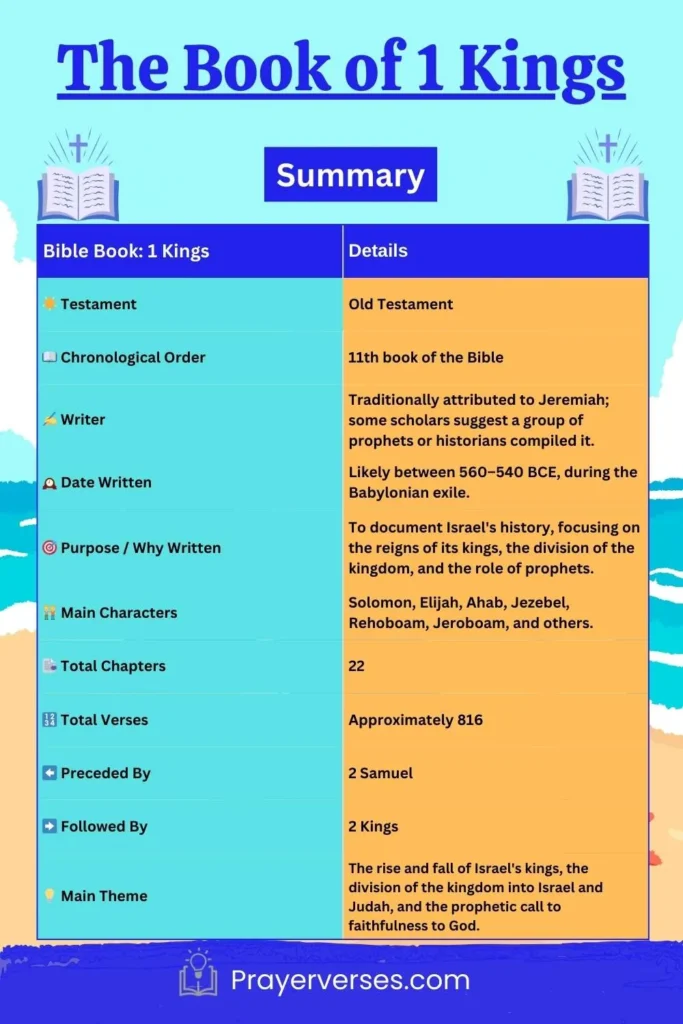
Summary
| Bible Book: 1 Kings | Details |
|---|---|
| 🌟 Testament | Old Testament |
| 📖 Chronological Order | 11th book of the Bible |
| ✍️ Writer | Traditionally attributed to Jeremiah; some scholars suggest a group of prophets or historians compiled it. |
| 🕰️ Date Written | Likely between 560–540 BCE, during the Babylonian exile. |
| 🎯 Purpose / Why Written | To document Israel’s history, focusing on the reigns of its kings, the division of the kingdom, and the role of prophets. |
| 🧑🤝🧑 Main Characters | Solomon, Elijah, Ahab, Jezebel, Rehoboam, Jeroboam, and others. |
| 📑 Total Chapters | 22 |
| 🔢 Total Verses | 816 |
| ⬅️ Preceded By | 2 Samuel |
| ➡️ Followed By | 2 Kings |
| 💡 Main Theme | The rise and fall of Israel’s kings, the division of the kingdom into Israel and Judah, and the prophetic call to faithfulness to God. |
1 Kings – Bible Book Overview
The book of 1 Kings picks up where the story of the Israelites left off after King David’s death. It starts with Solomon, David’s son, becoming king and leading the nation through a time of peace and prosperity (1 Kings 1:39). The book describes how Israel’s kingdom grows strong but also how it begins to crumble when its leaders turn away from God. By the end, the once-united kingdom splits into two parts, and God’s plan continues despite human failures.
Moreover, 1 Kings is not only about kings and their decisions. It shows how God stays in control, even when people make bad choices. The book is divided into two main sections: the first focuses on Solomon’s reign, including his wisdom and the building of the Temple (1 Kings 6:1). The second part covers the division of the kingdom and the rise of prophets like Elijah, Ascalonstantly, the book reminds us that obedience to God brings blessings, while disobedience leads to trouble.
Who Wrote 1 Kings and What’s Its Purpose
Nobody knows for sure who wrote 1 Kings, but many believe it was written by prophets or historians during or after the Babylonian exile, possibly with Jeremiah’s involvement. These writers were guided by God’s Spirit to record Israel’s history accurately. The main goal of the book is to show how the kings and people either followed God’s commands or turned away from them, and what happened because of those choices (1 Kings 2:3). It’s a history lesson, but it’s also a spiritual warning about the consequences of disobedience.
Furthermore, 1 Kings teaches that success isn’t about having power, wealth, or even wisdom alone. True success comes from obeying God and staying faithful to Him. For example, the book shows how Solomon’s choices led to both great achievements and terrible mistakes (1 Kings 11:4). By sharing these stories, 1 Kings encourages readers to learn from the past and choose faithfulness to God.

Additionally, the book serves as a reminder that God’s promises are unbreakable. Even when the kings failed, God kept His word to David about his family ruling Judah (1 Kings 9:5). This shows that God’s plans are bigger than human mistakes, offering hope for those who turn back to Him.
King Solomon’s Rise and Wisdom (1 Kings 1–11)
In the beginning of 1 Kings, King David is old and nearing the end of his life, so he chooses his son Solomon to be the next king (1 Kings 1:30). Solomon was young, but he had a huge job ahead of him—leading all of Israel. Early in his reign, God appeared to Solomon in a dream and offered to give him anything he wanted (1 Kings 3:5). Instead of asking for money or power, Solomon asked for wisdom to lead well, and God was so pleased that He gave Solomon wisdom, wealth, and honor (1 Kings 3:9–13).
As a result, Solomon became famous for his wise decisions. One well-known story is when two women came to him, both claiming to be the mother of the same baby (1 Kings 3:16–28). Solomon cleverly suggested cutting the baby in half, knowing the real mother would rather give up her child than see it harmed, and his plan worked perfectly. He also built the Temple in Jerusalem, a beautiful place for God’s presence to dwell among the people (1 Kings 6:1–14). This was a massive project that took seven years and showed Solomon’s devotion to God.
However, Solomon’s story takes a sad turn later on. Despite his wisdom, he married many foreign women who led him to worship idols (1 Kings 11:4). Because of this, his heart drifted from God, and God warned him that the kingdom would split after his death (1 Kings 11:11). This shows that even the wisest person can fall if they don’t stay close to God. Solomon’s life is a reminder to keep faith first, no matter how successful you become.
The Kingdom Splits: Israel and Judah (1 Kings 12–16)
After Solomon’s death, his son Rehoboam became king, but things quickly went wrong. The people asked him to lower the heavy taxes Solomon had imposed, but Rehoboam refused and spoke harshly to them (1 Kings 12:14). As a result, ten tribes rebelled and formed a new kingdom in the north called Israel, with Jeroboam as their king. The southern part, called Judah, stayed loyal to David’s family and followed Rehoboam (1 Kings 12:20). This split weakened the nation and caused years of conflict.
Furthermore, Jeroboam made a terrible decision in Israel. To keep people from traveling to Jerusalem to worship, he created two golden calves and told the people to worship them instead of God (1 Kings 12:28–30). This led Israel into idol worship, and most of their kings followed this bad example, pulling the nation further from God. In Judah, some kings tried to follow God, but others also turned to idols, causing trouble and division. Both kingdoms faced wars and struggles because of their choices.
Nevertheless, God didn’t abandon His people. He sent prophets to warn the kings and call them back to obedience. These prophets spoke boldly, reminding the people of God’s laws and His desire for them to return to Him. The stories in these chapters show how disobedience leads to chaos, but God’s mercy offers a way back through repentance.

The Prophet Elijah and God’s Power (1 Kings 17–19)
One of the most exciting parts of 1 Kings is the story of Elijah, a bold prophet sent by God during the reign of King Ahab (1 Kings 16:30). Ahab and his wife Jezebel were terrible leaders who encouraged Israel to worship the false god Baal instead of the true God. Elijah challenged this by confronting 450 prophets of Baal on Mount Carmel (1 Kings 18:19). He set up a test to see whose God would send fire from heaven, and while Baal’s prophets failed, God answered Elijah’s prayer with a powerful flame (1 Kings 18:38). This miracle proved that God is the only true God.
However, even after this victory, Elijah faced tough times. Jezebel threatened to kill him, so he fled to the wilderness, feeling scared and alone (1 Kings 19:3). There, God met him in a surprising way—not through a loud storm or fire, but through a gentle whisper (1 Kings 19:12). This moment showed Elijah that God is near, even in quiet times, and it gave him strength to keep going. It’s a reminder that God cares for us when we feel weak.
Moreover, Elijah’s story teaches us about courage and trust. He stood up to a powerful king and false prophets, relying on God’s power to show the truth. Even when he was afraid, God didn’t leave him but spoke gently to lift him. These chapters show that God’s strength is enough for any challenge, and He’s always close to those who seek Him.
Lessons from 1 Kings
The book of 1 Solomon’s story shows that leadership without faith leads to trouble. He had wisdom, wealth, and peace, but his heart turned away from God when he followed idols (1 Kings 11:4). Many kings after him made similar mistakes, choosing their own ways instead of God’s path, which caused their kingdoms to weaken and eventually fall. This teaches us that even the greatest gifts can’t replace a heart fully devoted to God. Staying faithful is the key to true success.
On the other hand, 1 Kings also shows God’s faithfulness. Even when the kings and people turned away, God sent prophets like Elijah to call them back (1 Kings 18:21). He kept His promise to David that his family would rule in Judah (1 Kings 9:5), showing that God’s plans stand firm no matter what. These stories encourage us to trust God’s mercy and turn back to Him when we mess up.
Additionally, the book reminds us that God cares about our hearts, not only our actions. The kings’ failures came from hearts that wandered from God, but He always offered a way back through repentance. This lesson applies to everyone—whether you’re a leader or not, God wants your whole heart. 1 Kings is a call to stay close to Him and trust His guidance in every part of life.
Key Verses from 1 Kings
Several verses in 1 Kings stand out for their powerful messages. For example, 1 Kings 2:3 says, “Observe what the Lord your God requires: Walk in obedience to Him… so that you may prosper in all you do.” This verse reminds us that obedience to God leads to true success. It’s a clear call to follow God’s commands in every decision we make.

Another key verse is 1 Kings 3:9, where Solomon asks, “Give your servant a discerning heart to govern your people and to distinguish between right and wrong.” This shows the value of wisdom that comes from God, not from our own efforts. Solomon’s request teaches us to seek God’s guidance when facing tough choices. Similarly, 1 Kings 8:61 calls us to be “fully committed to the Lord our God, to live by His decrees and obey His commands.”
Finally, 1 Kings 18:21 challenges us with Elijah’s bold question: “How long will you waver between two opinions? If the Lord is God, follow Him; but if Baal is God, follow him.” This verse pushes us to choose God wholeheartedly and avoid splitting our loyalty. Together, these verses point to God’s standards and the importance of complete devotion to Him.
Why 1 Kings Still Matters
Even though 1 Kings was written thousands of years ago, its lessons are still important today. It shows that faithfulness to God matters, especially when life gives you power, choices, or comfort (1 Kings 2:3). When the kings forgot God, their kingdoms faced problems, but when they turned back to Him, there was hope. This reminds us that our choices have consequences, but God’s mercy is always there.
Moreover, 1 Kings is more than a history book—it’s about God’s love for His people. Through every story, God sends prophets to warn and guide, showing He never gives up on us (1 Kings 18:38). The book calls everyone—leaders, families, and nations—to follow God with their whole hearts. By learning from the successes and failures of Israel’s kings, we can choose to live faithfully and trust God’s plan for our lives.
FAQs
FAQ 1: What is the book of 1 Kings in the Bible?
The Book of 1 Kings is part of the Old Testament and tells the history of Israel after the reign of David. It mainly focuses on the rule of Solomon, who was David’s son, and later the division of the kingdom into the northern kingdom (Israel) and the southern kingdom (Judah). This book records how the kings ruled, how the people worshiped, and how the prophets warned them when they turned away from God.
One of the most important sections is the story of King Solomon. His wisdom, his building of the Temple in Jerusalem (1 Kings 6), and his dedication prayer (1 Kings 8) are central moments in this book. But Solomon’s later years, when he allowed idolatry, show how even a wise king can fall.
The second part of 1 Kings tells the stories of other kings and the prophet Elijah, who stood boldly against idol worship, especially against King Ahab and Queen Jezebel (1 Kings 18). The book, therefore, is not only about history but also about faithfulness to God.

FAQ 2: What is the main message of the book of 1 Kings?
The main message of 1 Kings is that faithfulness to God leads to blessing, while turning away from Him leads to judgment. When Solomon obeyed the Lord and prayed for wisdom, his kingdom prospered greatly. But when he allowed foreign gods and idols into Israel, his kingdom began to fall apart (1 Kings 11).
Another strong theme is the importance of the Temple in Jerusalem as the center of worship. The building of the Temple showed God’s presence with His people and their need to honor Him with pure hearts. Solomon prayed, “May your eyes be open toward this temple night and day” (1 Kings 8:29), reminding everyone that true success comes from God’s favor.
The prophet Elijah’s bold stand on Mount Carmel (1 Kings 18) also shows the message that the Lord alone is God. He called on the people to stop wavering between false gods and the true God. Through stories like these, the book teaches that loyalty to the Lord is more powerful than riches, armies, or kings.
FAQ 3: What year was the book of 1 Kings written?
Scholars believe that 1 Kings was written during the time of the exile in Babylon, probably between 560–540 B.C. This was many years after the actual events happened. The stories about Solomon, the division of the kingdom, and the reigns of many kings were gathered and written down to help the people understand why their nation had fallen.
The book records events that span from about 970 B.C. (Solomon’s reign) to around 850 B.C., covering nearly 120 years of history. During this time, Israel went from being a strong united kingdom to a divided nation full of conflict. The timing of the writing is important because it helped the people in exile see that their struggles came from disobedience to God’s covenant.
This means 1 Kings is not just a history book, but also a lesson. By remembering the past, the exiles could see the consequences of sin and be reminded of the hope of returning to God’s promises.
FAQ 4: What is the purpose of the book of 1 and 2 Kings?
The purpose of 1 and 2 Kings is to show how God dealt with His people through their leaders, the kings. These books explain why the kingdom of Israel and Judah eventually fell. Each king’s reign is measured by one main standard: Did they walk in the ways of the Lord, or did they follow idols?

Another purpose is to reveal that God’s promises to David were still important. Even though many kings failed, God had promised that David’s line would not be cut off (2 Samuel 7:16). This points to the coming of the Messiah, who would be the true and faithful King.
The books also highlight the role of the prophets, such as Elijah and Elisha. Their voices reminded the people that God’s word is greater than the power of any throne. These lessons were meant to help later generations remain faithful and keep hope alive even in times of loss.
FAQ 5: Who wrote the book of Kings 1 and 2?
The human author of 1 and 2 Kings is not named directly in the Bible. Jewish tradition suggests that the prophet Jeremiah may have written or compiled these books, though some scholars believe they were written by another prophet or group of scribes during the exile. What is clear is that God inspired the writing through His Spirit (2 Timothy 3:16).
The style of the writing shows that the author had access to royal records, historical details, and prophetic traditions. Phrases like “as it is written in the Book of the Annals of the Kings of Judah” (1 Kings 14:29) show that the writer used earlier sources to give an accurate history. This makes the book both a historical record and a spiritual lesson.
While the exact writer may remain unknown, the purpose is very clear: to teach God’s people through the successes and failures of their leaders. The stories were arranged carefully to show that God rules over history and that His word is always true.
FAQ 6: How many kings are in the book of Kings?
The books of 1 Kings and 2 Kings together record the reigns of many kings from both the northern kingdom of Israel and the southern kingdom of Judah. After Solomon’s reign, the kingdom was divided. From then on, Israel had its own kings, and Judah had its own kings.
In total, there were 19 kings in Israel and 20 kings in Judah, though 1 and 2 Kings do not always tell all their stories in equal detail. Some kings, like Ahab of Israel (1 Kings 16:29–22:40), receive long sections because of their wickedness and their confrontations with prophets like Elijah. Others are mentioned only briefly because their reigns were short or less significant in the larger story.

The most important detail is not just how many kings there were, but how each one is judged by God’s standard. The Bible repeatedly says things like, “He did what was right in the eyes of the Lord” or, “He did evil in the eyes of the Lord” (1 Kings 15:11, 1 Kings 16:30). This pattern shows that what truly matters is not the length of a king’s rule, but whether he was faithful to the Lord.
Further Reading
- The Bible Book of Psalms – Meaning, Structure and Summary
- The Bible Book of Ruth: A Story of Loyalty, Faith and New Beginnings
- The Book of Zechariah: Prophecies, Visions and the Coming King
- Zephaniah in the Bible: A Clear Look at Its Message and Chapters
- The Book of Nehemiah: Story of Rebuilding, Leadership & Prayer