
Obadiah Bible Book: Meaning, Message and Chapter Breakdown
Obadiah speaks boldly about pride, betrayal, judgment, and God’s justice in the shortest prophetic book of the Bible, packed with powerful truth.
Introduction to the Book of Obadiah
The Book of Obadiah is a tiny but mighty book in the Old Testament, packed with a serious message. Despite being only one chapter with 21 verses, it delivers a strong lesson about justice, pride, and punishment. As one of the Minor Prophets, Obadiah is short, but its words carry weight and meaning for everyone. This book targets a nation called Edom, warning them about their wrong choices.
Moreover, Obadiah speaks for God, delivering a message that’s clear and direct. He warns Edom that their pride and cruel actions will lead to their downfall. At the same time, he offers hope to God’s people, showing that God sees their suffering and will act when the time is right. Even today, this ancient book reminds us that our actions matter and that God’s justice is always at work.
Interestingly, Obadiah’s message feels relevant because it talks about things we still see, like pride or unfair treatment. It shows that no one, no matter how strong, can escape the consequences of doing wrong. Therefore, this small book encourages us to think about how we treat others and trust that God is watching.
Summary
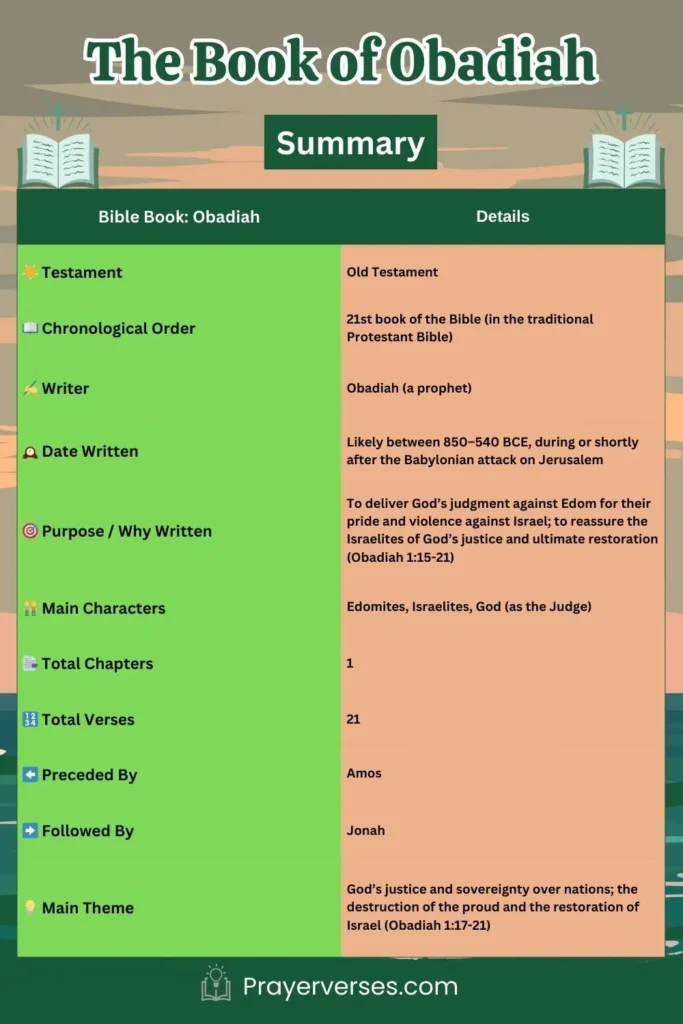
| Bible Book: Obadiah | Details |
|---|---|
| 🌟 Testament | Old Testament |
| 📖 Chronological Order | 21st book of the Bible (in the traditional Protestant Bible) |
| ✍️ Writer | Obadiah (a prophet) |
| 🕰️ Date Written | Likely between 850–540 BCE, during or shortly after the Babylonian attack on Jerusalem |
| 🎯 Purpose / Why Written | To deliver God’s judgment against Edom for their pride and violence against Israel; to reassure the Israelites of God’s justice and ultimate restoration (Obadiah 1:15-21) |
| 🧑🤝🧑 Main Characters | Edomites, Israelites, God (as the Judge) |
| 📑 Total Chapters | 1 |
| 🔢 Total Verses | 21 |
| ⬅️ Preceded By | Amos |
| ➡️ Followed By | Jonah |
| 💡 Main Theme | God’s justice and sovereignty over nations; the destruction of the proud and the restoration of Israel (Obadiah 1:17-21) |
Who Was Obadiah?
Unfortunately, we don’t know much about Obadiah as a person, which makes him a bit mysterious. His name means “servant of the Lord,” and that fits perfectly since he bravely shared God’s message (Obadiah 1:1). Some think he lived around 586 BC, when Jerusalem was attacked by Babylon, but the Bible doesn’t give us clear details. Still, his role was to speak truth, even when it was tough.
Furthermore, Obadiah’s words weren’t just for Edom; they also lifted the spirits of God’s people. At a time when they were hurting, he reminded them that God hadn’t forgotten them. His message was bold, calling out Edom’s wrongs while promising hope for those who trusted God. This shows how one person’s voice can make a big difference.
Although we lack details about Obadiah’s life, his message is crystal clear. He stood up against pride and cruelty, showing that God values justice. For this reason, Obadiah’s story encourages us to speak up for what’s right, even when it’s hard.
Background of Edom
To understand Obadiah, we need to know about the Edomites, who were related to the Israelites. They came from Esau, the twin brother of Jacob, making them like cousins to God’s people (Genesis 25:23–26). However, this family tie didn’t stop Edom from acting like an enemy. Instead of helping when Jerusalem was attacked, they joined in the destruction (Obadiah 1:11–14).
Additionally, Edom thought they were safe because they lived in mountain cities that were hard to reach (Obadiah 1:3). Their pride made them believe no one could touch them. But God saw their cruel actions, like cheering when Jerusalem fell or stealing from those in need. This betrayal broke God’s heart, especially since Edom and Israel were family.
As a result, Obadiah’s message is intense because it’s not about a random enemy—it’s about a broken family relationship. Edom had many chances to do the right thing, but they chose selfishness. Consequently, God warned that their pride would lead to their fall (Obadiah 1:4). This history helps us see why Obadiah’s words are so sharp and meaningful.
Themes and Messages
One big theme in Obadiah is pride, which Edom had in bucketloads. They thought their high mountain homes made them untouchable, but God said, “Though you soar like the eagle, I will bring you down” (Obadiah 1:4). This shows that no one is stronger than God, no matter how powerful they seem. Pride, then, is a dangerous trap that can lead to trouble.
Another key theme is justice, which God promises to deliver. Edom laughed and stole when Jerusalem was attacked, but God saw it all (Obadiah 1:15). He warned that their actions would come back to them, like a boomerang. This teaches us that God notices when people are treated unfairly and will step in.
Moreover, Obadiah brings hope to God’s people, even in tough times. God promised that Israel would get back what was taken from them (Obadiah 1:17). The book also talks about the Day of the Lord, a time when God will judge everyone fairly (Obadiah 1:15). For those who do wrong, it’s a warning, but for God’s people, it’s a promise of rescue.
Finally, the book ends with a powerful idea: God’s kingdom will win (Obadiah 1:21). This means God’s way of doing things—fairness, love, and truth—will last forever. These themes remind us to stay humble, treat others well, and trust God’s plan.
Short Breakdown of the Chapter
The Book of Obadiah has just one chapter, but it’s neatly split into three parts. The first part, verses 1–9, is about God’s judgment on Edom. God calls other nations to rise against Edom, saying their pride will lead to their downfall (Obadiah 1:1–4). Even their wise men and warriors won’t save them when God acts (Obadiah 1:8–9).
Next, verses 10–14 explain why Edom is in trouble. They acted like enemies instead of brothers when Jerusalem was attacked (Obadiah 1:10). They stood back, cheered, and even stopped people from escaping (Obadiah 1:11–14). These actions showed their hatred, and God lists their wrongs clearly.
Finally, verses 15–21 talk about the Day of the Lord and God’s kingdom. God says, “As you have done, it shall be done to you,” meaning everyone faces consequences (Obadiah 1:15). But there’s hope: Mount Zion will be holy, and God’s people will return home (Obadiah 1:17). The chapter ends with a strong promise: “The kingdom shall be the Lord’s” (Obadiah 1:21).
Each part builds on the last, making the chapter short but powerful. It moves from warning to explaining to promising hope. This structure helps us see God’s fairness and love in action.
Why This Matters Today
Even though Obadiah was written long ago, its lessons are still important. Pride, betrayal, and injustice happen today, just like they did back then. Obadiah reminds us that God sees when people are hurt and cares about fixing things. His message feels like it could have been written for our world.
Furthermore, the book shows that actions have consequences. When Edom chose cruelty, they faced God’s judgment (Obadiah 1:15). This encourages us to think about our choices and treat others with kindness, even when it’s hard. God’s justice means no one gets away with doing wrong forever.
Additionally, Obadiah offers hope to those who are struggling. Just as God promised to restore His people (Obadiah 1:17), He still cares for those who are hurting today. This book reminds us to trust that God is watching and will make things right.
In conclusion, the Book of Obadiah may be small, but its voice is loud. It challenges us to live humbly, act fairly, and trust in God’s plan. Its timeless message speaks to anyone who wants to do what’s right.
FAQs
1. What is the summary of the book of Obadiah?
The book of Obadiah is the shortest book in the Old Testament, yet it carries a powerful message. It focuses mainly on the nation of Edom and its relationship with Israel. Obadiah warns Edom for their pride and betrayal against their brother nation, Israel, and predicts their ultimate downfall (Obadiah 1:3-4).
The prophet emphasizes that God’s justice is inevitable. Those who act against His people will face consequences, while the faithful will experience restoration. The book moves quickly from warning to prophecy, showing both the punishment for Edom and the promise of deliverance for Israel (Obadiah 1:15-17).
In addition, Obadiah’s message highlights God’s sovereignty. He oversees all nations and will uphold righteousness. This book reminds readers that no act of cruelty or arrogance escapes God’s sight, making it a strong lesson on accountability.
2. What is the main point of Obadiah?
The central point of Obadiah is that pride leads to downfall, and God’s justice is certain. Edom is a key example; they trusted in their strong cities and wealth, yet their arrogance could not protect them from God’s judgment (Obadiah 1:3-4).
Moreover, the book underscores that God protects His people. While Edom suffers punishment, Israel is promised restoration. This contrast shows that God rewards faithfulness and punishes betrayal, making His justice both personal and national (Obadiah 1:17-18).
Another important aspect is the future hope for the faithful. Obadiah concludes by describing the kingdom of the Lord being established and all nations serving Him (Obadiah 1:21). This reinforces the idea that God’s plan is bigger than any single nation or conflict.
3. What is the famous verse in the book of Obadiah?
One of the most well-known verses in Obadiah is Obadiah 1:15: “The day of the Lord is near for all nations. As you have done, it shall be done to you; your deeds shall return on your own head.” This verse captures the theme of divine justice and shows that God measures actions fairly.
It emphasizes the principle of retribution, where nations face consequences for their choices. Edom’s pride and violence against Israel serve as a clear example of how God’s justice works in history. The verse reminds readers that God is attentive to every nation’s deeds, no matter how secure they seem.
Furthermore, Obadiah 1:21 is also significant: “Saviors shall go up to Mount Zion to rule Mount Esau; and the kingdom shall be the Lord’s.” This verse highlights hope and restoration for God’s people, offering a vision of His ultimate kingdom. Both verses together balance warning and promise.
4. Is Obadiah good or bad?
The book of Obadiah is neither “good” nor “bad” in a moral sense for humans, but it carries a serious warning. Its tone is strong and confrontational because it speaks against Edom’s pride and betrayal. Edom is criticized for violence, yet the book is meant to teach lessons about justice and faithfulness (Obadiah 1:10-14).
For Israel, it is a good and comforting message because it assures them of God’s protection. The faithful can trust that God will punish wrongdoers and restore His people. The book encourages humility, reliance on God, and adherence to His commandments.
It is also valuable spiritually because it demonstrates God’s fairness across nations. By studying Obadiah, readers learn that actions have consequences and that God’s plan ultimately favors righteousness. This makes the book a guide for reflection and moral insight rather than a story of simple good or bad.
5. Who wrote the book of Obadiah and when?
The book of Obadiah was written by the prophet Obadiah, whose name means “servant of the Lord.” Little is known about him personally, but the book identifies him as a messenger of God delivering a prophecy to Edom. Scholars debate the exact timing, but many place it around 586 B.C., during or after the Babylonian destruction of Jerusalem.
This timing is crucial because Edom had participated in Israel’s suffering, possibly helping Babylon against Judah (Obadiah 1:11-14). Obadiah’s message directly addresses their betrayal and warns of inevitable judgment.
The prophecy reflects both historical events and eternal truths. Even though the author’s personal details are limited, his writing provides a clear record of God’s justice and faithfulness, making Obadiah an essential book for understanding God’s plan for nations and His people (Obadiah 1:17, 1:21).