
Spiritual Meanings of Lazy Eye and Its Symbolism
A lazy eye holds deeper spiritual symbolism connected to perception, inner awareness, and life balance. This guide reveals what it signifies in the spiritual realm.
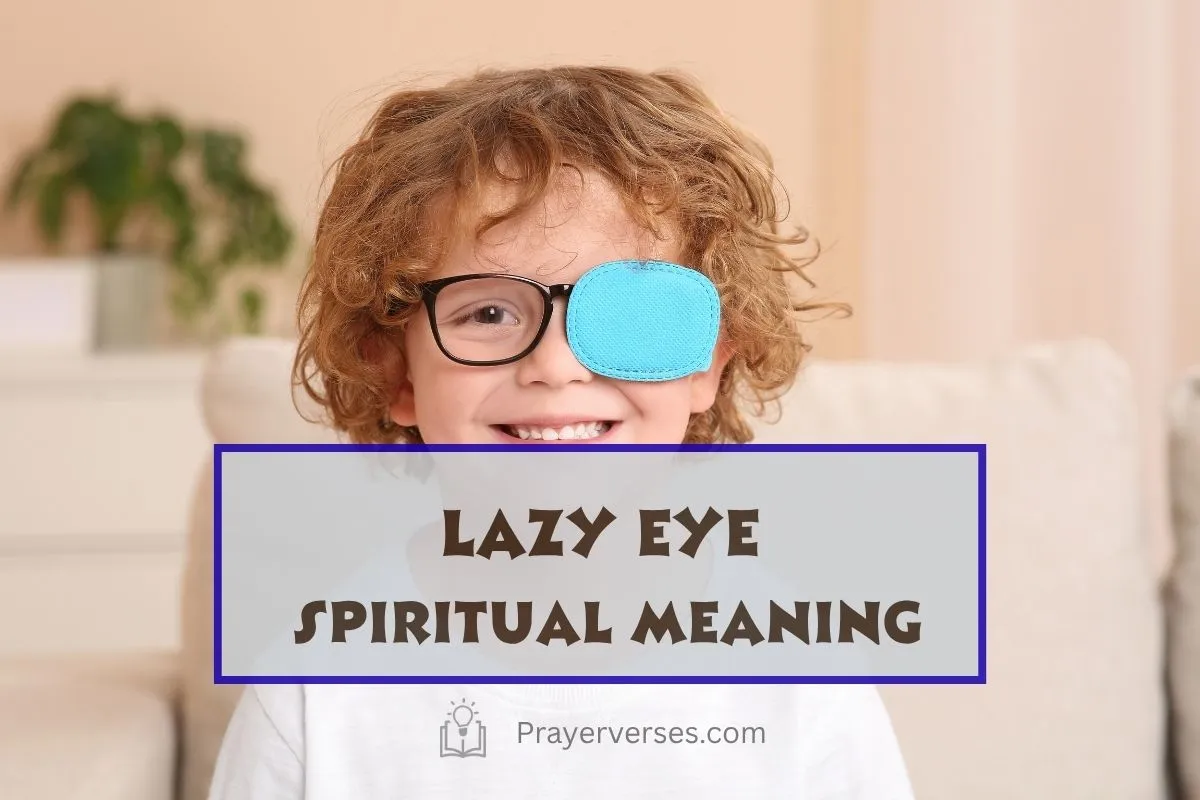
A lazy eye, known medically as amblyopia, is a condition where one eye doesn’t fully align or focus like the other. It often develops in childhood and may cause blurred or reduced vision in one eye. But beyond the physical, some believe this unique visual difference holds a deeper, spiritual significance.
Many cultures and spiritual traditions view physical traits — especially those related to the eyes — as mirrors of the soul. After all, the eyes are often called “the windows to the soul.” So when one eye sees differently than the other, it’s natural to wonder: does it reflect something deeper within?
Spiritually, a lazy eye can symbolize imbalance, hidden wisdom, a struggle between two inner perspectives, or even a lesson in how we perceive truth and reality. It can also represent the need to align inner vision with outer clarity — seeing life not just as it appears, but as it truly is.
Let’s explore the profound and symbolic meanings behind this condition and how it may connect to one’s spiritual journey.
What Do Lazy Eyes Represent Spiritually?
In spiritual philosophy, every physical condition or difference carries energetic meaning. The body often reflects what the soul is trying to express or heal. A lazy eye, therefore, isn’t just about physical sight — it’s about spiritual vision.
Someone with amblyopia may see the world unevenly — one eye dominant, one less active. Symbolically, this can represent duality within the self: the push and pull between the logical mind and intuitive soul, the physical and spiritual realms, or the conscious and subconscious mind.
Spiritually, the lazy eye can represent:

- An unbalanced perception of reality.
- Difficulty integrating two perspectives or truths.
- A lesson in seeing beyond surface appearances.
- An invitation to trust inner sight — intuition — over physical sight.
In many energy-healing traditions, the left and right eyes are linked to different aspects of awareness. The left eye often symbolizes the inner world, intuition, and the feminine or emotional self. The right eye connects to the outer world, logic, and masculine energy. When one eye underperforms, it may symbolize suppression or neglect of that aspect of life.
For example, a person with a weaker left eye might be encouraged, on a spiritual level, to reconnect with their intuition and emotions. Conversely, someone with a weaker right eye might need to ground their spiritual insights into practical, real-world action.
10 Spiritual Meanings of Lazy Eye or Amblyopia
Let’s dive deeper into ten possible spiritual interpretations and life lessons often associated with a lazy eye. Remember, these meanings are symbolic — not medical — and should be taken as insights for reflection rather than literal truths.
1. Imbalance Between the Physical and Spiritual Vision
A lazy eye can often represent a deeper spiritual imbalance between how you see the outer world and how you perceive your inner truth. In many esoteric traditions, the eyes are not merely organs of sight — they’re spiritual channels through which energy and awareness flow. When one eye doesn’t align properly, it may be a sign that your soul is trying to reconcile two forms of seeing: the physical and the spiritual.
In daily life, this might manifest as feeling torn between logic and intuition. You might excel in practical matters yet feel a quiet pull toward the mystical or unseen. The stronger eye symbolizes how you function in the physical realm — navigating work, relationships, and tangible realities. The weaker eye, meanwhile, represents your spiritual or intuitive sight — the subtle knowing that doesn’t rely on evidence but on inner awareness.
Spiritually, amblyopia can serve as a reminder to bring both forms of sight into balance. You’re being asked to align your outer focus (what you do) with your inner clarity (who you are). When you bridge that gap, your spiritual and physical vision begin to complement rather than compete with each other.
It’s not about “fixing” one side — it’s about allowing both to coexist in harmony, seeing life through both reason and revelation.

2. Difficulty Seeing Life from a Unified Perspective
When the eyes don’t work together, depth perception becomes difficult. Spiritually, this can represent a struggle to perceive the fullness of life — to see things as a unified whole rather than as separate fragments.
You might, for instance, find yourself swinging between extremes: optimism and doubt, faith and fear, confidence and insecurity. It’s as though your inner “vision” shifts focus depending on which part of you is dominant at the moment. One side of you sees clearly while the other lags behind — creating a sense of disconnection.
The lazy eye, in this sense, becomes a physical mirror for an inner state of dual awareness. You’re being invited to recognize that truth doesn’t always exist at one pole or the other — it lives in the space where both perspectives meet.
This symbolism teaches a beautiful lesson: life isn’t meant to be viewed in sharp contrasts. Instead of labeling experiences as right or wrong, good or bad, success or failure — you’re being encouraged to see them as part of one divine continuum.
Spiritually, healing begins not when both eyes see the same, but when both agree to see together — accepting duality as part of unity.
3. Hidden Wisdom or “Inner Sight”
Many people with amblyopia grow up relying more heavily on intuition or “feeling” their way through situations. Spiritually, this is no coincidence. The weaker physical vision often coincides with a stronger inner vision.
In mystical traditions, physical limitations can awaken latent abilities. When one sense diminishes, others sharpen — not just physically but energetically. A person with a lazy eye might develop a remarkable sensitivity to energy, emotion, or spiritual truth. They might “sense” when something is off in a room, feel emotions others hide, or have vivid dreams that seem to carry messages.

It’s as if the universe redirects the energy that would have gone to perfect eyesight into higher perception. What you lose in clarity of form, you gain in clarity of feeling.
From a soul perspective, this isn’t a defect — it’s a doorway. Amblyopia becomes an initiation into the unseen. It’s the soul’s quiet way of saying, “You don’t have to see everything with your eyes to know what’s real.”
This meaning encourages trust in your inner knowing. Even when your physical sight wavers, your spiritual sight is alive and deeply attuned. When you learn to listen to it, you begin to “see” far beyond what the physical eye can perceive.
4. Lesson in Acceptance and Self-Perception
Because the eyes are so closely tied to identity, having a visible difference in one’s gaze can affect how one feels about themselves. A lazy eye can sometimes bring feelings of self-consciousness, especially in a world that celebrates visual perfection. Yet spiritually, this very experience can become a profound teacher of self-acceptance.
Amblyopia asks: Can you love yourself even when something about you isn’t symmetrical, flawless, or easily understood by others?
For many, that journey of self-acceptance is transformative. The lazy eye becomes a metaphor for learning to see oneself through the eyes of compassion instead of comparison. It challenges the illusion that worth depends on appearance and reminds you that the soul’s beauty isn’t defined by physical alignment.
This lesson extends beyond self-image. It encourages you to accept others as well — to recognize that everyone has something about them that doesn’t “line up.” The physical eye’s imperfection thus becomes a living sermon about embracing human imperfection as divine design.

Spiritually, when you stop trying to “fix” what’s different and start honoring it as part of your uniqueness, you shift from judgment to grace. You begin to see — truly see — yourself as you are: perfectly imperfect, and deeply worthy.
5. A Symbol of Inner Conflict or Dual Awareness
One of the most striking spiritual interpretations of amblyopia is that it represents inner conflict. The eyes, being mirrors of consciousness, often reflect our internal divisions. When they don’t align, it can symbolize two parts of the self that are not yet in harmony.
This conflict might manifest as a struggle between logic and faith, or between worldly ambition and spiritual purpose. One eye — clear and dominant — might represent the rational, structured part of you that wants control and certainty. The other, unfocused eye might symbolize your spiritual side — fluid, intuitive, and open to the unknown.
Together, they form a dance of dual awareness: one eye looking outward at the physical world, the other gazing inward toward the divine. When the two can’t focus together, it may feel like being pulled between two realities — one demanding productivity and success, the other whispering for stillness and meaning.
This duality isn’t meant to be a curse but a catalyst. It teaches you the art of integration — learning to see with both heart and mind at once. The moment you stop forcing one to dominate the other, a quiet harmony begins to form.
From a higher perspective, a lazy eye may remind you that your spiritual evolution often begins in places of contradiction. It’s through reconciling opposites — body and soul, effort and surrender, clarity and blur — that true vision emerges.
6. A Reminder to Focus on What Truly Matters
In a literal sense, amblyopia affects focus — the ability of both eyes to align and fix on the same point. Spiritually, this mirrors how easily our minds and souls lose focus in life. We scatter our energy across countless distractions, letting our inner “vision” blur under the weight of external noise.
A lazy eye can symbolize the spiritual need to refocus. It’s as if the universe is gently asking, “What are you really looking at? What truly deserves your attention?”
When we focus on the superficial — on what others think, on competition, on appearances — we lose sight of what nourishes our soul. The blurred eye becomes a quiet teacher, reminding us that clarity comes not from perfect eyesight but from intentional sight.
In this way, amblyopia can serve as a symbolic nudge to simplify, to turn inward, and to choose depth over distraction. It encourages mindfulness — to look at life not through the clutter of comparison but through the clarity of purpose.
When you bring awareness back to what truly matters — peace, love, connection, and authenticity — your inner vision sharpens. You stop chasing focus outside yourself and instead find it where it always was: within.
7. Karma or Soul Contract Related to Perception
In many spiritual philosophies, including Hinduism, Buddhism, and esoteric Christianity, it’s believed that our souls choose certain life circumstances to evolve and grow. From this viewpoint, amblyopia might not be a random occurrence but part of a soul contract — an experience designed to teach specific lessons about perception, humility, or self-compassion.
Perhaps in a past life, sight or perception was taken for granted, or perhaps you once judged others based on appearances. This lifetime may then bring an opportunity to understand what it means to see beyond form.
A lazy eye could thus symbolize a karmic invitation to perceive reality differently — to depend less on physical appearances and more on spiritual awareness. You learn that not all clarity comes from what’s visible; sometimes, seeing less helps you feel more.
The karmic message is subtle yet profound: physical conditions often mirror the lessons our soul chose to master. Amblyopia may teach you patience, empathy, and the ability to recognize beauty even in imbalance. It humbles the ego and awakens compassion — not just toward others but toward yourself.
When you see your condition as part of a divine design rather than a flaw, it transforms your perception. You begin to understand that every experience, no matter how small, serves your soul’s unfolding purpose.
8. Seeing the World Differently — and That’s a Gift
People with a lazy eye often view the world from a slightly altered perspective — literally and metaphorically. Spiritually, this difference can be a unique gift.
While society tends to celebrate conformity, spiritual truth honors individuality. No two souls perceive the world the same way — and that’s precisely what makes life beautiful. Amblyopia can be a symbol of this diversity of perception, a reminder that your way of seeing things — even if it’s different — has value and purpose.
Many artists, mystics, and visionaries throughout history have been “different seers.” They noticed patterns, energies, or ideas others overlooked. In a similar way, a person with amblyopia might possess a richer inner world — a more imaginative, intuitive, or emotionally attuned way of perceiving life.
Spiritually, this meaning celebrates nonconformity. It invites you to embrace your unique vision, both literally and figuratively. You may not see the world as others do, but that doesn’t mean your vision is less valid — it might, in fact, be more profound.
Sometimes, what looks like a limitation from the outside is a deeper form of wisdom on the inside. So instead of asking, “Why can’t I see like everyone else?” the soul might whisper, “Maybe you were never meant to.”
9. Healing the “Inner Child” and Old Emotional Wounds
Because amblyopia usually develops in early childhood, it often carries emotional and energetic echoes from that time. Spiritually, this connection links the condition to the inner child — that innocent, creative part of you that still lives within, even as an adult.
A lazy eye may symbolically represent moments from childhood when you didn’t feel seen or acknowledged. Maybe your emotions were overlooked, or your imagination wasn’t valued. Over time, that feeling of being “unseen” can manifest physically — as though one eye turned inward to look at the hidden self that others ignored.
Healing this spiritual layer involves reconnecting with that inner child — giving them the love, validation, and presence they once longed for. When you visualize yourself holding and comforting that child within, you begin to restore emotional clarity and balance.
Some energy healers even say that when the inner child feels seen, the eyes of the soul realign. You begin to perceive life with softness again — not from a place of survival, but from a place of wholeness.
This meaning reminds us that spiritual healing often begins with emotional truth. The lazy eye, in this context, is not a flaw but a messenger from your past, inviting you to turn your gaze inward and heal what was once unseen.
10. Trusting Intuition Over Outer Appearances
Perhaps the most profound spiritual message of all is this: trust what your inner eye sees, even when your physical eyes cannot.
In our modern world, we’re conditioned to rely almost entirely on what we can see, touch, or measure. But spiritual wisdom teaches that truth often hides beyond appearances. A lazy eye may serve as a symbolic reminder to stop depending solely on outer vision and start awakening inner sight.

The “lazy” eye, then, becomes a misnomer. Maybe it isn’t lazy at all — maybe it’s simply turned inward, attuned to a deeper form of seeing. It might represent the soul’s quiet rebellion against superficiality, a subtle way of saying, “Look within. That’s where the truth lies.”
When you begin to trust intuition — that gentle whisper that guides without demanding proof — you awaken what ancient mystics called the eye of the heart. This is where true vision lives: not in perfect eyesight, but in pure awareness.
So if you or someone you love has amblyopia, take heart. On a soul level, it may signify not a defect, but a gift — an invitation to move through life guided by inner knowing rather than outer illusion.
Cultural Significance of Lazy Eyes
Throughout history, different cultures have interpreted physical differences — especially related to the eyes — in fascinating ways.
In ancient Egypt, the Eye of Horus symbol represented protection, healing, and divine vision. Interestingly, the symbol itself is asymmetrical — one side more dominant than the other. Some spiritual interpreters link this imbalance to the harmony between intuition and rationality, much like the symbolism of a lazy eye.
In Eastern philosophy, the concept of “inner sight” or third eye awakening suggests that physical imperfections in the eyes can be gateways to spiritual insight. In this view, a lazy eye might represent the process of opening the ajna chakra — learning to perceive truth beyond ordinary vision.
Among Native American tribes, eyes were seen as sacred instruments of perception and connection with spirit beings. A difference in the eyes was sometimes seen as a mark of spiritual sensitivity — a person able to perceive beyond the physical world.
Meanwhile, in modern culture, amblyopia may be viewed through a psychological or symbolic lens. Artists and philosophers sometimes interpret it as a metaphor for the fragmented way we experience reality — each of us “seeing” only parts of the truth until we integrate all perspectives.
Myths, Superstitions, or Beliefs About Lazy Eye
Across various cultures, eye-related superstitions are incredibly common. The lazy eye, though less discussed than traits like eye color or twitching, still carries intriguing myths.
- The “Two Worlds” Myth:
Some old European and African folk beliefs held that people with differently aligned eyes could see both the spiritual and physical realms. A lazy eye was seen as a sign of connection to the unseen — a bridge between worlds. - Protection from Evil Spirits:
In some Middle Eastern traditions, an asymmetrical gaze was thought to confuse or repel the “evil eye.” It was believed that such a person couldn’t be easily cursed because their gaze reflected two realities at once. - The “Watcher” Archetype:
Ancient myths often described seers or shamans who “saw differently.” They might appear to have one wandering eye, symbolizing their ability to perceive what others could not — hidden truths, spirits, or distant events. - Luck and Destiny:
In certain Asian cultures, facial differences including the eyes were linked to destiny readings. A misaligned eye could indicate a destiny filled with spiritual challenges but also deep insight or artistic vision.
While these myths can sound mystical, they all point to one thing — difference as sacred. The lazy eye, far from being a flaw, was once seen as a mark of spiritual uniqueness.
Biblical Meanings of Lazy Eye
From a Biblical or Christian spiritual lens, the eyes hold immense symbolism. Scripture often associates the eyes with understanding, morality, and purity of heart.
In Matthew 6:22-23 (KJV), Jesus says:
“The light of the body is the eye: if therefore thine eye be single, thy whole body shall be full of light.”
This verse suggests that spiritual clarity — having a “single” or focused eye — fills one’s soul with divine light. Conversely, when the “eye is evil,” or divided, the inner world becomes darkened.

Spiritually speaking, a lazy eye could represent the journey from duality to unity. It’s a metaphor for aligning one’s spiritual vision — becoming “single-eyed” in purpose and faith. The imbalance in sight mirrors the human struggle between worldly distractions and divine focus.
Another interpretation comes from 2 Corinthians 5:7:
“For we walk by faith, not by sight.”
This reminds believers that spiritual perception transcends physical sight. Even if one eye doesn’t see clearly, the heart can still perceive God’s truth. Thus, a lazy eye can symbolize faith beyond appearances — the ability to trust what’s unseen.
Some Christian mystics even interpret physical imperfections as divine tools for humility and deeper spiritual understanding. Through limitation, the soul learns compassion, gratitude, and awareness that true vision comes from God.
Final Thoughts
The lazy eye, though often viewed medically, carries layers of spiritual meaning when we look deeper. It speaks to perception, balance, and the mysterious ways our bodies mirror our inner worlds.
Spiritually, it reminds us that:
- Vision isn’t only about what we see, but how we see.
- Physical imbalance can awaken deeper understanding.
- Each difference, even in the eyes, holds a divine message about unity, compassion, and acceptance.
Perhaps the deeper message of amblyopia is this: sometimes, clarity isn’t about seeing more — it’s about seeing differently. When one eye doesn’t align perfectly, maybe it’s life’s gentle way of teaching us to view the world from another angle — through empathy, intuition, and spiritual depth.
In the end, the lazy eye becomes a beautiful metaphor for every soul’s journey — imperfect, asymmetrical, yet profoundly capable of seeing truth through the heart’s vision.
You Might Also Like
1) Spiritual Meanings of Mole in Eye: Eyeball, Eyelid or Eyebrow
2) Spiritual Meanings of Central Heterochromia, Superstitions, Myths
3) Blue Eyes Spiritual Meanings, Superstitions, & Myths
4) Green Eyes Spiritual Meanings, Superstitions, & Myths
5) Golden Eyes or Amber Eyes Spiritual Meanings & Myths