
Ezekiel – Bible Book Meaning, Chapters, Themes, and Lessons
Ezekiel contains powerful visions and deep messages from God through a prophet during exile. Each chapter reveals something important.
Introduction to the Book of Ezekiel
The Book of Ezekiel is one of the major prophetic books in the Old Testament, named after the prophet who received visions and messages from God. Ezekiel lived during a very hard time in Israel’s history—the Babylonian exile, when many Israelites were taken far from their homes. This book speaks directly to that pain, confusion, and loss.
Ezekiel was not only a prophet, but also a priest (Ezekiel 1:3), which means he deeply understood worship and the temple system. His role was unique because he spoke God’s words while living in a foreign land, far from the temple in Jerusalem. This gave him a strong voice among the exiles, especially when they were tempted to give up on God.
God gave Ezekiel strong, clear, and often shocking visions to share with the people. His job was to tell them the truth—both about their past sins and about the hope that could come after repentance. That balance between judgment and restoration runs through the entire book.
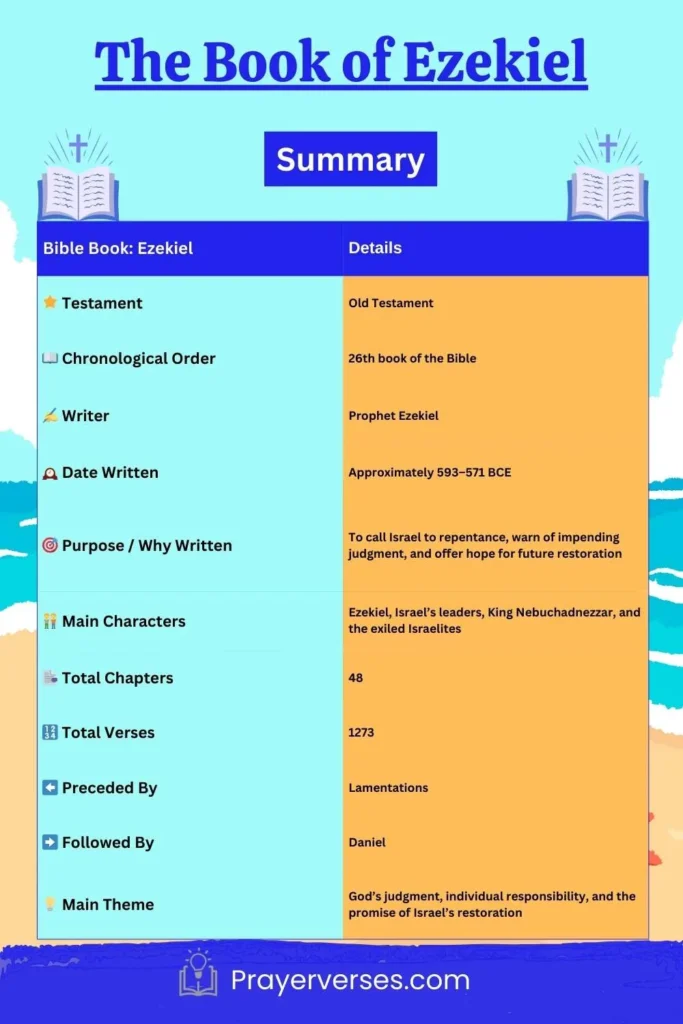
Summary
| Bible Book: Ezekiel | Details |
|---|---|
| 🌟 Testament | Old Testament |
| 📖 Chronological Order | 26th book of the Bible |
| ✍️ Writer | Prophet Ezekiel |
| 🕰️ Date Written | Approximately 593–571 BCE |
| 🎯 Purpose / Why Written | To call Israel to repentance, warn of impending judgment, and offer hope for future restoration |
| 🧑🤝🧑 Main Characters | Ezekiel, Israel’s leaders, King Nebuchadnezzar, and the exiled Israelites |
| 📑 Total Chapters | 48 |
| 🔢 Total Verses | 1,273 |
| ⬅️ Preceded By | Lamentations |
| ➡️ Followed By | Daniel |
| 💡 Main Theme | God’s judgment, individual responsibility, and the promise of Israel’s restoration |
Who Was Ezekiel?
Ezekiel was born into a priestly family, which meant he was supposed to serve in the temple one day. But before he could begin his work there, Jerusalem was invaded by the Babylonian king Nebuchadnezzar, and Ezekiel was taken to Babylon in one of the early groups of captives around 597 BC.
He began receiving visions from God five years after the exile began (Ezekiel 1:2). From that point on, his life changed completely. Instead of serving in a physical temple, he became a messenger for God’s spiritual truths. Even in a foreign land, he stayed loyal to his calling.
God used Ezekiel in powerful ways. Through visions, symbolic acts, and detailed prophecies, Ezekiel warned the people that God saw everything they did. But even when his messages were hard to hear, they always came from a place of truth and care.
Structure and Summary of Ezekiel’s Chapters
The Book of Ezekiel is divided into 48 chapters, and it can be broken down into three main sections. Each part has its own focus, but together they build a clear picture of what God was doing with His people during that time.
Chapters 1–24 are focused on God’s judgment against Jerusalem and Judah. These chapters explain why destruction was coming. Ezekiel speaks strongly about the sins of the people, the corruption in the temple, and their unfaithfulness to God (Ezekiel 8:9–18). He also uses symbols and drama to make his points, like lying on his side for days (Ezekiel 4:4–6) or shaving his head to show God’s anger (Ezekiel 5:1–4).
Chapters 25–32 turn toward the nations around Israel, such as Ammon, Moab, Edom, Egypt, and others. Ezekiel tells them that they too would face consequences for their pride and cruelty. These messages show that God cares about justice everywhere, not just in Israel.
Then, in Chapters 33–48, the focus changes to hope and restoration. Once Jerusalem had fallen, Ezekiel was called to give messages of comfort. He spoke about a new heart and spirit (Ezekiel 36:26), the valley of dry bones coming to life (Ezekiel 37:1–14), and even a future temple (Ezekiel 40–48) where God would dwell with His people again.
Major Themes in the Book of Ezekiel
One of the biggest themes in Ezekiel is God’s presence, especially in difficult times. Right at the start, Ezekiel sees a vision of God’s glory on a moving throne-chariot (Ezekiel 1:4–28). This shows that God is not limited to the temple in Jerusalem. He can be with His people even in exile.
Another major theme is personal responsibility. God tells Ezekiel that everyone is responsible for their own actions (Ezekiel 18:20). This was important because many people thought they were being punished for what their ancestors did. But God wanted them to know that each person could choose to follow Him and live.
Restoration and new life also play a big part in the second half of the book. After all the talk about judgment, God starts speaking about healing, unity, and a future filled with His peace. The vision of the dry bones (Ezekiel 37) is a perfect example—it’s a picture of how God can bring hope, even when everything seems dead.
The Visions of Ezekiel
Ezekiel is well known for his amazing and detailed visions, which are filled with symbols. In Chapter 1, he sees four living creatures, wheels within wheels, and bright lights, all representing God’s glory and power. This vision shows that God is holy and beyond human limits.
Later, Ezekiel sees the departure of God’s glory from the temple (Ezekiel 10), which is a sad but powerful moment. It means God is no longer staying in a place where people have rejected Him. But near the end of the book, there’s a beautiful change—God’s glory returns to the new temple (Ezekiel 43:1–5), showing that God still loves His people.
One of the most moving visions is in Ezekiel 37, where the prophet is brought to a valley full of dry bones. God tells him to speak to the bones, and they begin to come together, get flesh, and receive breath. This shows that even when people feel completely hopeless, God can bring new life.
God’s Promises and the New Covenant
Even though much of Ezekiel’s message is serious and even painful, it leads to hope and future promise. In Ezekiel 36:26–27, God says He will give His people a new heart and a new spirit. This promise points forward to a time when people would be able to follow God more closely—not by force, but by love.
God also talks about unity in Ezekiel 37:15–28, saying that the divided kingdoms of Israel and Judah will be joined into one nation again. He promises peace, safety, and a leader like David to rule them. Many believe this is a picture of the Messiah, pointing ahead to Jesus Christ.
Ezekiel’s final chapters show a detailed vision of a new temple, a restored land, and God’s presence returning to live among His people (Ezekiel 40–48). The last words of the book are powerful: “The Lord is there” (Ezekiel 48:35). That’s the message Ezekiel leaves with his readers—God will not leave His people forever.
Why Ezekiel Still Matters
Even though Ezekiel was written thousands of years ago, its message still speaks today. It reminds us that God sees all things, both good and bad. He calls people to turn back to Him, but He also promises restoration, healing, and new life.
The book challenges us to think deeply about faithfulness, repentance, and hope. It tells us that no situation is too broken for God to repair. Through strange visions and strong words, Ezekiel leads people back to a deep connection with God.

Whether you’re reading it for the first time or going back to study it again, Ezekiel teaches that God is holy, powerful, and full of mercy. He speaks through prophets, works through hard times, and keeps His promises—even when everything feels lost.
FAQs
1. What is the summary of the book of Ezekiel?
The Book of Ezekiel is a profound and vivid prophetic book in the Old Testament. It contains a mix of visions, symbolic acts, warnings, and promises given by Ezekiel, who was both a prophet and a priest. The book begins with Ezekiel’s dramatic vision of God’s glory, showing four living creatures and a chariot-like throne, which emphasizes God’s sovereignty (Ezekiel 1:1-28).
Much of Ezekiel’s message focuses on judgment against Israel for their idolatry and disobedience. He uses symbolic actions, such as lying on his side or shaving his head, to convey God’s warnings in a visible way (Ezekiel 4:1-17). These acts helped the exiled Israelites understand the seriousness of their rebellion.
Alongside judgment, Ezekiel also gives hope for restoration. Chapters 33 to 48 describe the return of God’s people, the rebuilding of the temple, and the promise of a renewed covenant (Ezekiel 36:24-28). The book balances warnings with God’s mercy, showing that even after punishment, God’s love and plan for restoration remain.
2. What is the main message of Ezekiel?
The main message of Ezekiel is that God is holy, powerful, and sovereign, and He will hold His people accountable for their actions. Throughout the book, Ezekiel emphasizes that Israel’s sins cannot go unnoticed, yet God’s plans also include restoration and renewal for the faithful (Ezekiel 18:30-32).
Another key point is the call to repentance and personal responsibility. Ezekiel stresses that each person is responsible for their own actions, and God will judge accordingly. The famous verse, “The soul who sins shall die” (Ezekiel 18:4), reminds the Israelites that repentance can bring mercy and forgiveness.
Ezekiel also communicates hope for the future, using the vision of the valley of dry bones (Ezekiel 37:1-14) to symbolize Israel’s spiritual revival. This shows that God can restore even those who seem hopelessly broken, and His plans extend beyond punishment to renewal and spiritual life.
3. What is Ezekiel in the Bible famous for?
Ezekiel is famous for his extraordinary visions, symbolic actions, and prophecies of judgment and restoration. His opening vision of the living creatures and God’s throne is one of the most detailed and remarkable visions in the Bible (Ezekiel 1:1-28). This vision demonstrates God’s majesty and power, capturing the attention of readers across generations.
He is also known for using symbolic acts to convey messages, such as lying on his side to bear Israel’s sins or dividing his hair to represent different fates for the people (Ezekiel 4:1-17). These actions made his prophecies tangible and unforgettable.
Moreover, Ezekiel is famous for the valley of dry bones vision, where God promises to bring life to the lifeless, symbolizing Israel’s restoration (Ezekiel 37:1-14). This message of hope and renewal is one reason Ezekiel remains one of the most powerful prophetic voices in the Bible.
4. Who wrote Ezekiel in the Bible and when?
The prophet Ezekiel, a priest living in exile in Babylon, is the author of the book. He received divine revelations and wrote them down to communicate God’s messages to the Israelites. Ezekiel lived during a critical period in Israel’s history, witnessing the destruction of Jerusalem in 586 B.C. (Ezekiel 1:1-3).
He began his prophetic ministry around 593 B.C., during the early years of the Babylonian exile, and continued for about 22 years. Ezekiel’s background as a priest gave him unique insight into temple rituals and holiness, which he often referenced in his prophecies (Ezekiel 40–48).
The book itself reflects both historical events and spiritual teachings. By writing in a combination of narrative, visions, and symbolic acts, Ezekiel ensured that the Israelites in exile would understand God’s judgment, mercy, and plan for future restoration.
5. When was Ezekiel written in the Bible?
The Book of Ezekiel was written during the Babylonian exile, mainly between 593 B.C. and 571 B.C. This period was one of great upheaval for the Israelites, as they were far from their homeland and had witnessed the destruction of Jerusalem. The book reflects both the historical context and the spiritual struggles of the people in exile (Ezekiel 1:2-3).

Ezekiel’s writings are chronological, starting with his initial visions and calling, followed by prophecies against Israel and surrounding nations (Ezekiel 2:1–32:32). Later chapters focus on hope, restoration, and the new temple (Ezekiel 33–48). The careful sequence of events helps readers understand God’s plan unfolding over time.
The timing of Ezekiel’s writing is significant because it allowed the exiled Israelites to see God’s judgment and promises in perspective. It reassures them that even in their most difficult moments, God remained sovereign and faithful, providing a path for renewal and hope (Ezekiel 36:24-28).