
Micah in the Bible: Message, Prophecies and Chapters Explained
Micah speaks truth about injustice, God’s judgment, and a future filled with hope and restoration for His people.
Introduction
Micah was one of the twelve minor prophets in the Old Testament, but his words carried huge weight. He lived around 750–686 BC, a tough time for both Israel and Judah, when people were struggling with unfair leaders and broken systems. Unlike some prophets who used tricky language, Micah spoke in a way that was clear and straight to the point. His message focused on justice, mercy, and staying close to God, which still feels super relevant today.
Micah didn’t shy away from calling out leaders, judges, and even religious officials who were hurting the poor or twisting the truth. For example, he boldly pointed out how the rich were cheating the poor out of their land (Micah 2:1–2). Yet, he also shared a hopeful vision of a future where God would make things right again. His words in Micah 6:8—to act justly, love mercy, and walk humbly with God—are like a guide for how we should live today.
What makes Micah special is how he balanced warnings with promises. He told people about God’s anger toward sin but also His love and desire to forgive. His prophecies, like the one about a ruler from Bethlehem (Micah 5:2), gave people hope, even in dark times. This mix of truth and hope makes Micah’s message powerful, even for us now.
Summary
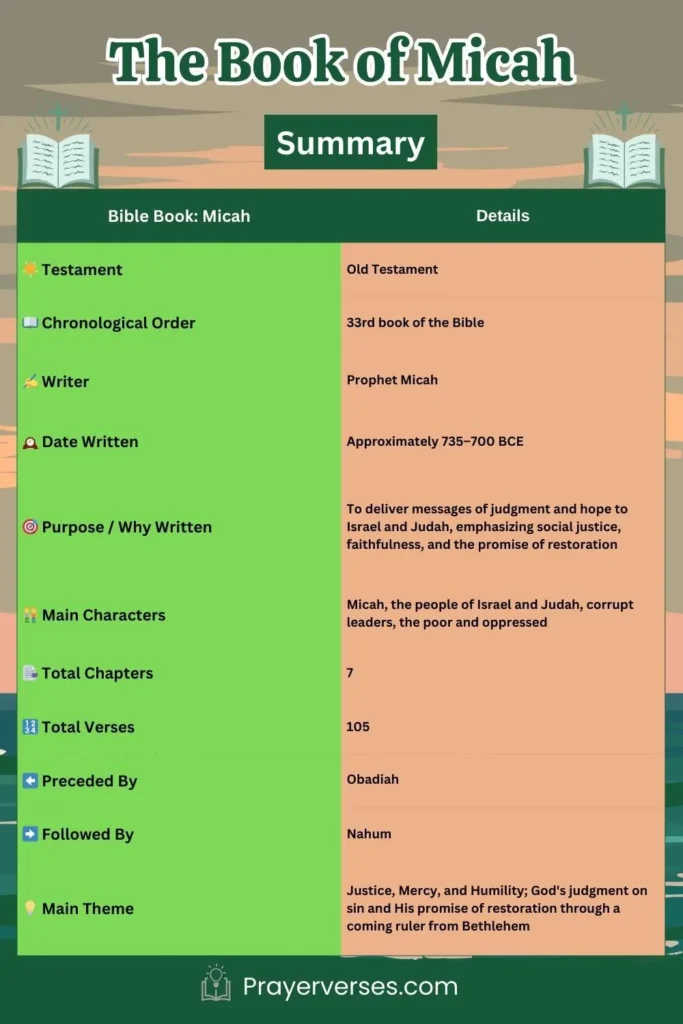
| Bible Book: Micah | Details |
|---|---|
| 🌟 Testament | Old Testament |
| 📖 Chronological Order | 33rd book of the Bible |
| ✍️ Writer | Prophet Micah |
| 🕰️ Date Written | Approximately 735–700 BCE |
| 🎯 Purpose / Why Written | To deliver messages of judgment and hope to Israel and Judah, emphasizing social justice, faithfulness, and the promise of restoration |
| 🧑🤝🧑 Main Characters | Micah, the people of Israel and Judah, corrupt leaders, the poor and oppressed |
| 📑 Total Chapters | 7 |
| 🔢 Total Verses | 105 |
| ⬅️ Preceded By | Obadiah |
| ➡️ Followed By | Nahum |
| 💡 Main Theme | Justice, Mercy, and Humility; God’s judgment on sin and His promise of restoration through a coming ruler from Bethlehem |
The Message of Micah: Justice, Judgment, and Hope
Micah’s main message was that God cares deeply about how we treat each other. He saw rich people stealing from the poor and called them out for it (Micah 2:1–2). Leaders were taking bribes instead of doing what was right, and Micah wasn’t afraid to say it (Micah 3:11). Even religious leaders were using their roles to make money instead of sharing God’s truth.
However, Micah didn’t only talk about what was wrong. He also shared God’s kindness and patience, promising a future where people from all over would worship God in peace (Micah 4:1–3). This gave people something to hold onto during hard times. It showed that God’s plan wasn’t only about punishment but also about restoration.
Micah’s tone moves between warning and comfort, like a teacher who corrects you but also encourages you. For instance, he spoke of a ruler from Bethlehem who would bring peace (Micah 5:2), which many believe points to Jesus. His words remind us that God’s love is bigger than His anger. By the end of the book, Micah says God “delights in showing mercy” (Micah 7:18), which is a beautiful reminder that God wants to forgive.
This balance of truth and hope makes Micah’s message stand out. He wasn’t only speaking to people back then; his words still challenge us to live better and trust God’s promises. Whether it’s standing up for what’s right or believing in a brighter future, Micah’s words push us to act with courage and faith.
Chapters of Micah: A Quick Breakdown
Micah’s book has seven chapters, and each one builds on the themes of judgment, justice, and restoration. In Chapter 1, Micah paints a dramatic picture of God coming to judge Samaria and Jerusalem because of their sins (Micah 1:6–7). It’s a warning that their actions have serious consequences. This chapter sets the stage, showing how serious God is about sin.
Chapter 2 focuses on the rich who were plotting evil at night and acting on it by morning (Micah 2:1). They were taking land from the poor, and Micah called it out as wrong. But the chapter ends with a promise that God will gather His faithful people one day. This mix of warning and hope keeps readers paying attention.
In Chapter 3, Micah gets even tougher, speaking directly to corrupt leaders and prophets. He compares them to people who “tear the skin from my people” (Micah 3:2), which is a strong way to show how their actions hurt others. This chapter is all about holding people in power accountable. It’s a reminder that God sees everything and cares about fairness.
Chapter 4 shifts to a hopeful vision of the future, where God’s house is lifted high, and people live in peace (Micah 4:4). The Chapter 5 continues this hope, talking about a ruler from Bethlehem who will be a shepherd and bring peace (Micah 5:4–5). The Chapter 6 includes the famous verse about acting justly, loving mercy, and walking humbly (Micah 6:8), while Chapter 7 ends with trust in God’s forgiveness (Micah 7:7, 7:19). Each chapter weaves together warnings and promises, making the book short but packed with meaning.
Micah 6:8 – The Heart of the Book
One verse in Micah stands out above the rest: Micah 6:8. It says, “He has shown you, O man, what is good,” and then explains what God wants—to act justly, love mercy, and walk humbly with Him. This verse is simple but powerful, like a rule for life that anyone can understand. It’s not about fancy religious acts; it’s about how we treat people every day.
This verse has inspired people for centuries because it’s so clear. It’s been quoted in speeches, sermons, and even carved into buildings because it sums up what God cares about most. Instead of focusing on big rituals, Micah 6:8 tells us to live with fairness, show kindness, and stay close to God. It’s a message that feels just as important now as it did back then.
Micah’s words remind us that faith is about action, not just beliefs. Treating people fairly, being kind, and staying humble are things we can all work on. This verse is like a guide that helps us make good choices every day. It’s no wonder so many people turn to Micah 6:8 for wisdom and inspiration.
The Historical Setting and Background
Micah came from a small town called Moresheth, near the border of Judah. He lived during the reigns of three kings—Jotham, Ahaz, and Hezekiah (Micah 1:1)—when the Assyrian Empire was growing stronger and scaring everyone. Both Israel in the north and Judah in the south were facing big problems, like unfair treatment of the poor and leaders who weren’t trustworthy. This tough setting shaped Micah’s bold message.
During this time, people were turning away from God, and injustice was everywhere. The rich were cheating the poor, and leaders were making decisions based on bribes instead of what was right. Micah saw all this and couldn’t stay quiet. His words were strong because he cared about the people and wanted them to change before things got worse.
Micah’s message wasn’t just about pointing out what was wrong; it was also about hope. He warned people about the consequences of their actions but also shared God’s promise to fix what was broken. His love for his people and his trust in God’s plan made his words powerful, even in such a difficult time.
Micah’s Prophecies and Their Fulfillment
Micah’s prophecies weren’t just for his time; some of them came true later, and others are still waiting to happen. For example, he said Jerusalem would become a heap of ruins (Micah 3:12), and that happened when Babylon attacked years later. This showed that Micah’s warnings were serious and true. His words carried weight because they came from God.
One of Micah’s most famous prophecies is about a ruler born in Bethlehem (Micah 5:2). This came true with the birth of Jesus Christ, and the New Testament even quotes Micah in Matthew 2:5–6. This prophecy shows how Micah’s words reached far beyond his own time. It’s a reminder that God’s plans are bigger than we can imagine.
Micah also spoke of a future time of peace, where nations would stop fighting, and people would live without fear (Micah 4:3–4). This hasn’t fully happened yet, but many believe it points to a time when God will bring peace to the world. Micah’s prophecies give us hope that God is working on something bigger, even when things seem tough.
Why Micah Still Matters Today
Micah’s words are still important because they talk about justice, mercy, and faith in ways that connect with us now. Even though he lived thousands of years ago, the problems he saw—like corrupt leaders and unfair systems—are still around today. His message challenges us to think about how we treat others and how we live our lives. It’s a call to action that feels just as fresh now.

What makes Micah’s book so powerful is its hope. He shows that God doesn’t stay angry forever and wants to forgive and fix what’s broken (Micah 7:18–19). This gives us confidence that things can get better, even when the world feels messy. Micah’s words encourage us to trust God’s plan and live in a way that makes a difference.
The book of Micah is short, but its message is loud and clear. It reminds us to act justly, love mercy, and walk humbly with God (Micah 6:8). By following these ideas, we can live better and help make the world a kinder place. Micah’s voice still speaks, guiding us toward a life of faith and fairness.
FAQs
1. What is the summary of the book of Micah?
The Book of Micah is a prophetic book in the Old Testament that focuses on the judgment and restoration of Israel and Judah. It reveals the moral decay, injustice, and idolatry present in the land while warning about the consequences of turning away from God. Micah calls out leaders, priests, and prophets who exploit the poor, showing God’s deep concern for justice and righteousness (Micah 3:1-12).
The book also offers hope and redemption, promising that a faithful remnant will survive and that God will restore peace and prosperity. One of the most famous passages, Micah 6:8, emphasizes that God desires His people to act justly, love mercy, and walk humbly with Him. The final chapters highlight the coming of a ruler from Bethlehem who will bring security and salvation, pointing to the Messiah (Micah 5:2).
In short, Micah blends warnings, ethical teachings, and hope, showing how God addresses human sin while offering a path toward restoration. Its messages are relevant because they encourage justice, compassion, and faithfulness in daily life.
2. What is the Book of Micah known for?
The Book of Micah is known for its strong emphasis on social justice. The prophet criticizes the oppression of the poor, dishonest leaders, and corrupt practices among religious authorities. Micah warns that ignoring God’s commandments leads to destruction, which makes it a book that blends moral urgency with divine prophecy (Micah 1:5-7).
It is also recognized for its prophecies about the Messiah. Micah predicts that a ruler will come from Bethlehem to guide God’s people with peace and security (Micah 5:2). Furthermore, the book is famous for Micah 6:8, a concise statement that defines God’s expectations for human conduct. The combination of ethical teaching, judgment, and hope makes Micah a unique prophetic book.
Another reason it stands out is its literary style. Micah uses vivid imagery, metaphors, and contrasts between sin and restoration to capture attention. This makes it memorable and impactful for readers across generations.
3. Who was Micah in the Bible and how did he die?
Micah was a prophet from Moresheth, a small town in Judah, who lived during the 8th century BCE. He preached during a time of political instability and moral corruption in both Israel and Judah. His role was to call people back to God’s covenant, pointing out the injustices of rulers and the spiritual decay among the nation (Micah 3:9-12).
The Bible does not provide specific details about Micah’s death, unlike some other prophets. His legacy is recorded in the book bearing his name, which preserves his messages, warnings, and prophecies. Despite the absence of details on his death, his influence endured because of the enduring spiritual lessons and prophecies he left for Israel and Judah.
Micah is remembered as a faithful prophet who balanced judgment with hope. He demonstrated that God values integrity, mercy, and humility over religious rituals, making his life and words meaningful for generations.
4. What happened to Micah in the Bible?
In the Bible, Micah’s life is primarily known through his prophetic ministry rather than specific events. He delivered messages from God warning about the consequences of sin and corruption in Judah and Israel. He spoke boldly against leaders who exploited the poor, confronting them with God’s displeasure (Micah 3:1-12).
Micah also foretold the destruction of Samaria and Jerusalem if the people failed to repent. Yet, he assured them of God’s mercy, emphasizing that a faithful remnant would remain and that God would eventually restore peace and righteousness (Micah 4:1-5). His prophecies about the coming Messiah brought hope amid judgment, showing that God has a plan for redemption.
Through his words, Micah became a voice of justice and hope, calling people to live in accordance with God’s will. His life illustrates the challenges prophets face when confronting social injustice and moral decay in society.
5. Who wrote the Book of Micah in the Bible and when?
The Book of Micah was written by the prophet Micah himself, who lived in the 8th century BCE. He prophesied during the reigns of Jotham, Ahaz, and Hezekiah, kings of Judah (Micah 1:1). His writings reflect the social, political, and spiritual issues of that time, addressing both Israel and Judah with warnings of judgment and promises of restoration.
The book was likely composed over a period, reflecting different phases of Micah’s ministry. Early chapters emphasize God’s judgment, while later chapters focus on hope, the restoration of a remnant, and the coming Messiah. This chronological structure helps readers see the balance between justice and mercy in God’s plan (Micah 7:18-20).
Micah’s authorship is important because it links the messages directly to a historical prophet who experienced the events firsthand. His words provide authentic insights into God’s expectations and the spiritual climate of 8th-century Judah.