
The Book of Nehemiah: Story of Rebuilding, Leadership & Prayer
The Book of Nehemiah shows how one man’s faith and leadership helped restore a broken city and its people.

Introduction
The Book of Nehemiah, found in the Old Testament, tells an inspiring story about a man named Nehemiah who helped fix a broken city and lift the spirits of his people. He wasn’t a prophet or a priest, but a regular guy working in a king’s palace, with a heart full of love for God and His people. Nehemiah lived far away from Jerusalem, yet he cared deeply about its troubles. When he heard the city’s walls were destroyed and its gates burned (Nehemiah 1:3), he felt sad but didn’t sit still. Instead, he prayed, planned, and took bold steps to make things better, showing how faith and leadership can change lives.
This story is exciting because it shows how one person’s courage can spark big changes. Nehemiah’s journey teaches us that anyone, no matter their job, can do great things with God’s help. His prayers, hard work, and trust in God brought hope to a discouraged nation. By rebuilding Jerusalem’s walls, he helped the people feel safe and reconnect with God. Let’s dive into Nehemiah’s story to see how he led with strength and faith.
Summary
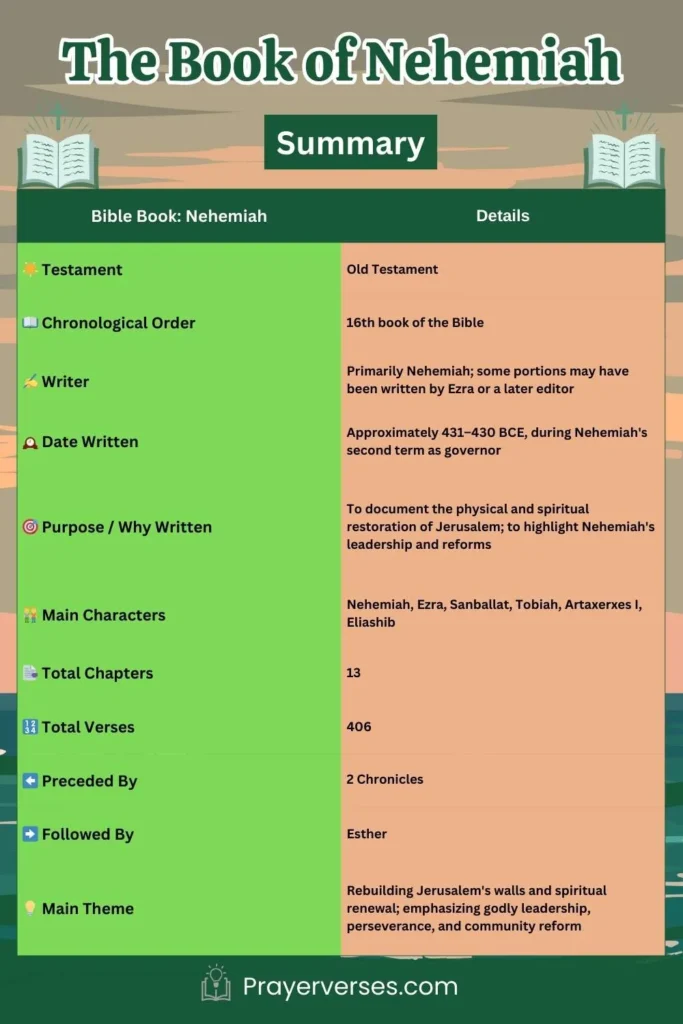
| Bible Book: Nehemiah | Details |
|---|---|
| 🌟 Testament | Old Testament |
| 📖 Chronological Order | 16th book of the Bible |
| ✍️ Writer | Primarily Nehemiah; some portions may have been written by Ezra or a later editor |
| 🕰️ Date Written | Approximately 431–430 BCE, during Nehemiah’s second term as governor |
| 🎯 Purpose / Why Written | To document the physical and spiritual restoration of Jerusalem; to highlight Nehemiah’s leadership and reforms |
| 🧑🤝🧑 Main Characters | Nehemiah, Ezra, Sanballat, Tobiah, Artaxerxes I, Eliashib |
| 📑 Total Chapters | 13 |
| 🔢 Total Verses | Approximately 406 |
| ⬅️ Preceded By | The Book of 2 Chronicles |
| ➡️ Followed By | The Book of Esther |
| 💡 Main Theme | Rebuilding Jerusalem’s walls and spiritual renewal; emphasizing godly leadership, perseverance, and community reform |
Who Was Nehemiah?
Nehemiah worked as a cupbearer for King Artaxerxes in Persia (Nehemiah 1:11), a job that sounds simple but was super important. As a cupbearer, he tasted the king’s drinks to make sure they weren’t poisoned, which meant the king trusted him a lot. Even though he lived in a fancy palace, Nehemiah never forgot his Jewish roots. His heart stayed tied to his people in Jerusalem, even from far away.
When Nehemiah heard that Jerusalem’s walls were broken and its gates burned (Nehemiah 1:3), he didn’t ignore the bad news. He cried, fasted, and prayed to God for days (Nehemiah 1:4–11), showing how much he cared. Unlike some people who might complain or give up, Nehemiah turned to God for help. His love for his people and his trust in God pushed him to act, setting the stage for an amazing adventure.
This part of Nehemiah’s story shows how ordinary people can do extraordinary things. He wasn’t a king or a warrior, but his heart for God made him a leader. His example encourages us to care about others and trust God, even when things seem tough. Nehemiah’s first step was to pray, which led to big changes for his people.
Nehemiah’s Prayer and God’s Favor
Before doing anything, Nehemiah turned to prayer, pouring out his heart to God (Nehemiah 1:4–11). He admitted the wrongs his people had done, asked for forgiveness, and reminded God of His promises (Nehemiah 1:6–7). His prayers were honest and full of faith, showing he believed God could fix the problem. For months, he prayed and waited for the right moment to act.
One day, King Artaxerxes noticed Nehemiah looked sad and asked why (Nehemiah 2:2). Even though Nehemiah was scared, he bravely told the king about Jerusalem’s troubles (Nehemiah 2:3–5). He asked for permission to go rebuild the city’s walls, and because of God’s favor, the king said yes! The king even gave Nehemiah letters for safe travel and supplies to help with the work (Nehemiah 2:7–8).

This moment shows how prayer can open doors. Nehemiah didn’t rush ahead; he waited on God and trusted Him to make a way. His courage to speak to the king, even when afraid, teaches us to be bold when God leads us. God’s favor turned Nehemiah’s sadness into a chance to help his people.
Nehemiah’s story here reminds us that waiting on God is powerful. His prayers weren’t just words—they led to real action. When we pray and trust God, He can work through us, even in scary situations. Nehemiah’s faith helped him take the first big step toward rebuilding Jerusalem.
Chapters at a Glance
The Book of Nehemiah has 13 chapters, each showing a different part of Nehemiah’s incredible journey. In Chapters 1–2, Nehemiah hears about Jerusalem’s broken walls, prays, and gets the king’s permission to rebuild (Nehemiah 1:1–2:8). These chapters show how his faith and planning started the whole mission. It’s like the beginning of a big adventure where Nehemiah steps up as a leader.
In Chapters 3–6, the people work together to rebuild the wall, but they face enemies like Sanballat and Tobiah who try to stop them (Nehemiah 4:1–6:16). Despite threats, Nehemiah keeps everyone focused and the wall gets finished in just 52 days (Nehemiah 6:15). These chapters are full of action, showing how teamwork and trust in God overcome challenges. The wall’s completion was a huge victory for the people.
Chapters 7–10 focus on organizing the city and renewing the people’s faith (Nehemiah 7:1–10:39). Ezra reads God’s Law, and the people confess their sins and promise to follow God again (Nehemiah 8:1–10:31). Finally, Chapters 11–13 show Nehemiah setting up leaders and fixing problems, like people breaking God’s rules (Nehemiah 13:7–31). Each chapter builds on the last, showing how Nehemiah led the people back to God.
Rebuilding the Wall
Rebuilding Jerusalem’s wall was a massive job because it had been broken for years (Nehemiah 3:1–32). Nehemiah didn’t do it alone; he organized the people into teams, with each group fixing a part of the wall. Families, priests, and even goldsmiths worked side by side, showing amazing teamwork. This plan made the work faster and gave everyone a sense of purpose.
However, enemies like Sanballat and Tobiah mocked the workers and threatened to attack (Nehemiah 4:1–3). Nehemiah didn’t let fear stop him; he encouraged the people to trust God and keep going (Nehemiah 4:14). Some workers even held tools in one hand and weapons in the other to stay ready (Nehemiah 4:17). Their hard work paid off, and the wall was finished in just 52 days, surprising everyone who doubted them (Nehemiah 6:15–16).

This part of the story shows how determination can beat tough challenges. Nehemiah’s leadership kept everyone focused, even when things got scary. The rebuilt wall made Jerusalem safe again and showed God’s power. It’s a reminder that working together with faith can do big things.
Facing Opposition and Staying Focused
Nehemiah faced more than just a broken wall—he dealt with enemies who wanted to stop the work. Leaders like Sanballat, Tobiah, and Geshem tried to trick Nehemiah into meeting them to slow him down (Nehemiah 6:2). But Nehemiah was smart and said, “I am doing a great work and I cannot come down” (Nehemiah 6:3). His focus stayed on the wall, not the distractions.
The enemies also spread lies to make Nehemiah and the people afraid (Nehemiah 6:5–9). Instead of giving up, Nehemiah prayed a short but powerful prayer: “Now strengthen my hands” (Nehemiah 6:9). His faith kept him strong, even when others felt tired or scared. By staying focused, he led the people to finish the wall despite all the trouble.
This part of Nehemiah’s story teaches us to stay focused when things get hard. Enemies tried to pull him away, but he kept his eyes on the goal. His prayers and determination show how to handle challenges. We can learn from Nehemiah to keep going, even when others try to stop us.
Spiritual Renewal and Reading of the Law
After the wall was built, the people gathered to hear Ezra read God’s Law (Nehemiah 8:1–3). They stood for hours, listening carefully, and many cried because they realized they hadn’t followed God’s ways (Nehemiah 8:9). This moment was a big wake-up call for the people. They saw how far they had drifted from God.
Nehemiah didn’t let them stay sad; he told them, “The joy of the Lord is your strength” (Nehemiah 8:10). This encouraged the people to celebrate and start following God’s rules again, like the Feast of Tabernacles (Nehemiah 8:17). The reading of the Law sparked a spiritual renewal that changed their hearts. It was like hitting a reset button for their faith.
This part of the story shows how God’s Word can bring people back to Him. The people didn’t just listen—they acted on what they heard. Nehemiah’s leadership helped them turn their sadness into joy. It reminds us that God’s truth can guide us and give us strength.

Covenant Renewal and Recommitment
After hearing the Law, the people confessed their sins and made a new promise to follow God (Nehemiah 9:1–10:31). They agreed to keep the Sabbath, avoid marrying people who didn’t worship God, and support the temple (Nehemiah 10:28–31). This wasn’t just talk; they wanted to live differently. Their covenant showed a serious commitment to God.
Nehemiah also organized leaders, priests, and Levites to keep the city and temple running smoothly (Nehemiah 11:1–12:47). This helped the people stay on track with their promise. By setting up clear rules and roles, Nehemiah made sure their faith would last. It was like building a strong foundation for their renewed relationship with God.
This moment in the story highlights the power of recommitment. The people didn’t just feel sorry—they took action to change. Nehemiah’s leadership made their promise real and lasting. It shows us that following God means making choices to live His way every day.
Nehemiah’s Final Reforms
Even after the wall was built and the people promised to follow God, problems came up again. When Nehemiah returned from a trip to the king, he found some people letting enemies stay in the temple and others working on the Sabbath (Nehemiah 13:7–17). This was disappointing, but Nehemiah didn’t give up. He took bold steps to fix things.
Nehemiah kicked out the troublemakers, warned the people, and made sure the priests did their jobs right (Nehemiah 13:10–30). He ended the book with a prayer: “Remember me, my God, for good” (Nehemiah 13:31). His heart was always focused on serving God and keeping His people faithful. These final reforms showed his commitment to God’s ways.
This part of Nehemiah’s story teaches us that faithfulness takes ongoing effort. Even when things go wrong, we can keep working to make them right. Nehemiah’s bold actions and prayers inspire us to stay true to God. His life shows that leading well means never giving up on what’s right.
Why Nehemiah Still Matters
Nehemiah’s story is important because it shows how faith, prayer, and leadership can change things, even in tough times. He started as a cupbearer, not a big leader, but his love for God made him a hero. His story encourages us to step up and help others, no matter who we are. Anyone with a heart for God can make a difference.

Nehemiah faced many challenges, but he kept praying, planning, and working with others (Nehemiah 4:14, 6:9). His example teaches us to stay strong and trust God, even when things seem impossible. Rebuilding the wall and renewing the people’s faith took teamwork and time. Nehemiah’s life reminds us that God can use us to fix broken things and bring hope.
FAQs
1. What is the summary of the book of Nehemiah?
The Book of Nehemiah tells the story of how the Israelites returned from exile and rebuilt Jerusalem’s walls after the Babylonian captivity. It begins with Nehemiah receiving troubling news about Jerusalem’s broken walls and devastated gates. He prays to God, seeks permission from King Artaxerxes, and is allowed to return to Jerusalem as governor to restore the city (Nehemiah 1:4-11).
Once in Jerusalem, Nehemiah faces opposition from surrounding enemies like Sanballat and Tobiah, but he organizes the people to rebuild the walls despite threats. The book emphasizes faith, leadership, and perseverance, showing how dedication to God can overcome obstacles. Nehemiah divides the work among families, encourages vigilance, and relies heavily on prayer for guidance and protection (Nehemiah 4:6, 9).
The later chapters focus on spiritual reforms, including the renewal of the covenant, dedication of the wall, and the revival of worship practices. Nehemiah reminds the Israelites to follow God’s law, bring tithes and offerings, and care for the poor. The book ends with a restoration of faith and community, demonstrating that physical and spiritual rebuilding go hand in hand (Nehemiah 8:9-10; 10:28-29).
2. What is the famous verse in the book of Nehemiah?
One of the most famous verses in Nehemiah is Nehemiah 4:14: “Don’t be afraid of them. Remember the Lord, who is great and awesome, and fight for your families, your sons and your daughters, your wives and your homes.” This verse captures the courage and trust in God that Nehemiah encouraged among the Israelites.
The verse comes at a time when enemies mocked and threatened the builders. Nehemiah reminds the people to focus on God’s power rather than fear, highlighting how faith can give strength in the face of danger. The encouragement here is practical and spiritual, urging both action and prayer together.
Another well-known verse is Nehemiah 2:20: “The God of heaven will give us success. We His servants will start rebuilding.” This verse shows Nehemiah’s confidence in God’s guidance and emphasizes that success comes through obedience, planning, and reliance on God. Both verses are often cited in sermons and devotionals to inspire leadership, courage, and commitment.

4. Was Nehemiah a prophet?
Nehemiah is not classified as a prophet in the Bible. Prophets typically received direct messages from God to deliver to the people, often warning of judgment or calling for repentance. Nehemiah’s role was more administrative and leadership-oriented, focusing on rebuilding Jerusalem and guiding the community (Nehemiah 2:17-18).
However, his work had prophetic qualities because he emphasized obedience to God’s law and encouraged spiritual reform. Through his actions, Nehemiah called the people to faithful living, prayer, and renewal of the covenant, which aligns with the broader goals of prophetic ministry (Nehemiah 8:13-18).
While he did not receive visions or speak God’s messages as prophets like Isaiah or Jeremiah, Nehemiah demonstrated a God-centered vision. His guidance and reforms inspired the Israelites to turn back to God, showing that leadership and spiritual influence can have prophetic impact without the formal title.
5. Who wrote the Book of Nehemiah in the Bible and when?
The Book of Nehemiah is traditionally attributed to Nehemiah himself, though some scholars suggest Ezra may have contributed to its final composition. The book is considered a mix of first-person memoir, official records, and historical narrative, which gives readers both personal insight and historical context (Nehemiah 1:1-2; 7:5).
It was likely written around 445–432 B.C., shortly after the events described. Nehemiah records his own travels, the rebuilding of Jerusalem’s walls, and the spiritual reforms, indicating the text was written by someone who experienced the events firsthand.
The book’s style includes prayers, lists, speeches, and accounts of opposition, giving it a detailed and authentic feel. This combination of personal memoir and historical record makes the Book of Nehemiah a valuable resource for understanding God’s guidance in leadership and community restoration (Nehemiah 13:23-27).
Further Reading
- Haggai Bible Book Meaning, Message, and Chapter Summary
- Genesis – The First Book of the Bible, Meanings and Summary
- 2 Samuel – Bible Book Meaning, Summary, and Key Lessons
- Habakkuk in the Bible: Message, Questions, and Meaning
- 1 Chronicles – Meaning, Context & Lessons from the Bible Book